 GET STARTED
 CURRENT STUDENT LOGIN


If there’s one myth I wish I could erase from the dog world, it’s that behavior is caused by dominance, stubbornness, or spite.
Spoiler alert… it’s not! Behavior is information. It’s your dog’s way of communicating with you and is shaped by things like health, genetics, environment, learning history, sleep, stress, and even your own body language.
When we treat behavior as communication rather than misbehavior, we can finally understand what’s really going on.
Sometimes behavior seems random. Other times, training can be emotional… whether you’re embarrassed by your dog’s reaction to the neighbor (…again!), sleep deprived from your new puppy or just having an off day. Trying to objectively understand and interpret our dog’s behavior thoroughly is difficult!
Enter one of my favorite tools… data! 🤓
By keeping track of our dog’s behaviors we can begin to identify patterns and trends that shape our training plan. It can help us pinpoint potential triggers, evaluate whether a supplement is helping, track progress and more! Data tracking may sound science-y but it can be done very simply and effectively… or you can nerd out over an Excel spreadsheet. Choose your own adventure!
Why Track Behavior?
Behavior tracking is one of the easiest ways to improve training results. Here are the four main reasons to do it:
1. Better Management
Management is always step one when it comes to changing behavior. If a dog can’t practice the unwanted behavior, it becomes easier to change it. By keeping track of the occurrence of the undesirable behavior in the first place we can begin to understand whether our management plan is effective.
Example: If your puppy has been having accidents in the living room, a recommendation might be to gate that area off. Then we can track if the puppy is having accidents elsewhere and how often. (Sometimes interrupting a habitual behavior can be very helpful!)
2. Remove the Guesswork
Humans naturally remember the hard moments more than the smooth ones. If someone tells me I did a great job, I’ll forget about it by the next day. That time I embarrassed myself in 4th grade? You bet that still haunts me!
Tracking removes emotion, giving you a clear picture of what’s actually happening so you can see progress you might otherwise miss.
Example: Your dog has had 5 walks with no reaction in the last two weeks. Hooray! You have an off day and they have a big, over the top reaction when they get startled by a dog on leash. The latter is important to note but we have to factor in the successes, too!
3. Clearer Trends Over Time
Behavior change is not linear. You will have great days, tough days, and “what is happening?” days. By recording these behaviors through data, we can identify trends and adjust training plans accordingly.
Example: Your dog seems to randomly snap at your other dog but you can’t figure out why. By tracking your dog’s behavior and activities for each day, we notice it’s only happening after he goes on a hike. This lets us know we may want to look at the possibility of pain contributing or being overtired. (Much like kids, overtired pups get grumpy, too!)
4. Better Communication With Professionals
If you’re working with a trainer, a vet, or both, recorded observations are incredibly helpful. Notes about what happened, when it happened, and what happened beforehand can dramatically speed up the process of evaluating possible causes and effectiveness of training plans and/or medical care.
What Should You Track?
This depends on your goals, but here are commonly useful data points:
-
Date and time
-
Location
-
Who was handling the dog
-
What the dog did
-
What happened right before (the antecedent)
-
Body language
-
Exercise or enrichment that day
-
Food or water intake (for certain cases)
-
Medications or supplements
-
Your dog’s emotional response
-
Your emotional response (yes, this matters too!)
That being said, you do not need to track all of this! Most families only need a small subset, depending on the behavior we’re addressing.
The Four Essentials (Your “Starter Pack”)
If you track nothing else, start with these:
-
When it happened
-
Where it happened
-
What the dog did
-
What happened right before it
These four pieces alone can identify patterns, triggers, and opportunities for training.
Examples
Potty Training
A simple log might include:
- Time of elimination
- Type of elimination
- Where it happened
- What happened right before
- Who was handling or watching the puppy
These logs help you quickly identify schedules, patterns and help prevent accidents.
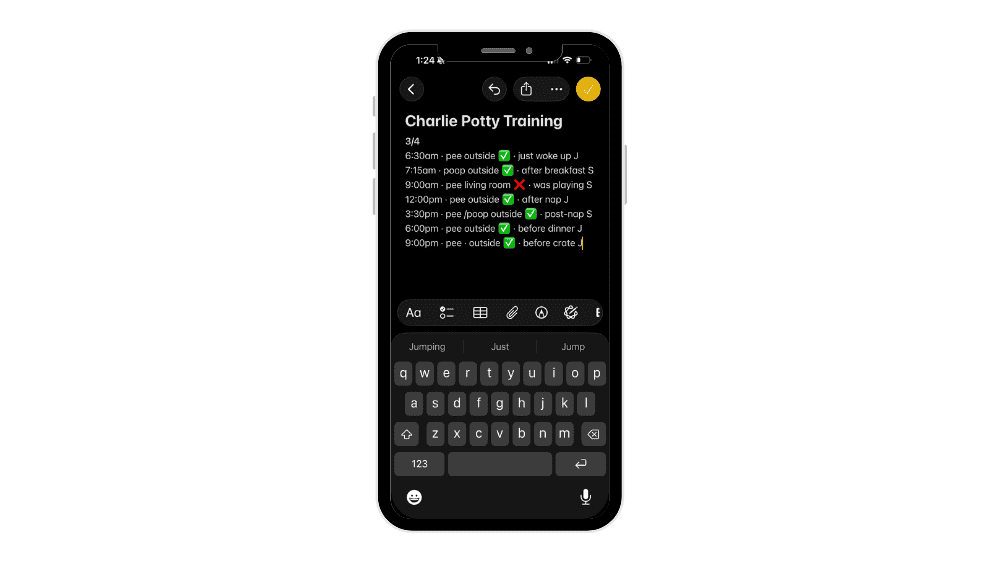
A potty training example.
Puppy Witching Hour
Many puppies become wild in the evening because they’re overtired. Tracking can include:
-
Nap times and lengths
-
When the “chaos” began
-
What behaviors you saw (biting, zoomies, jumping)
-
What you tried
-
How long it took to settle
This makes it easier to adjust the day’s rhythm and reduce the overwhelm.
Reactivity
Reactivity tracking is often more detailed:
-
Date/Time
-
Location
-
Trigger type (dog, person, car, noise)
-
Distance from trigger
-
Reaction intensity
-
Duration of recovery
-
Antecedents (for example, a stressful vet visit that morning)
-
Medications or supplements
-
Reinforcers used
This information helps create more accurate training plans and reveals which strategies work best.
Using a Rating Scale
Quantifying behavior removes emotion and makes patterns easier to see. For reactivity, a 1–5 scale might look like:
1 – Intense reaction; barking and lunging; unable to respond to well-known cues
2 – Intense Barking but no lunge
3 – Brief reaction, able to disengage
4 – Watches trigger but stays quiet
5 – Goal behavior; looks at trigger and then calmly back at you
You can use a scale like this for many behaviors, from potty training to noise sensitivity.
How to Track (Without Overcomplicating It)
You do not need a fancy spreadsheet (though you can certainly make one!). Some families prefer to use simple, on-the-go tools they can use anytime (like their notes app!).
Here are simple options:
-
A notepad or printed tracker on the fridge
-
A notes app
-
Texting yourself
-
Calendar entries
-
Simple checkboxes or emojis
The method doesn’t matter as long as it’s doable and consistent.
The Big Takeaway
Tracking isn’t about perfection. It’s about understanding your dog on a deeper level, reducing frustration, and making training more effective. When you track behavior consistently, patterns emerge, progress becomes clearer, and you gain a roadmap for what your dog needs!
If you’re a member of Where Sit Happens, you have access to detailed trackers and step-by-step guides inside our resource library. If you’re not a member yet, this overview gives you a great starting point and a look at the kind of support we provide inside our programs!




0 Comments